Four references that make the comparison clearer
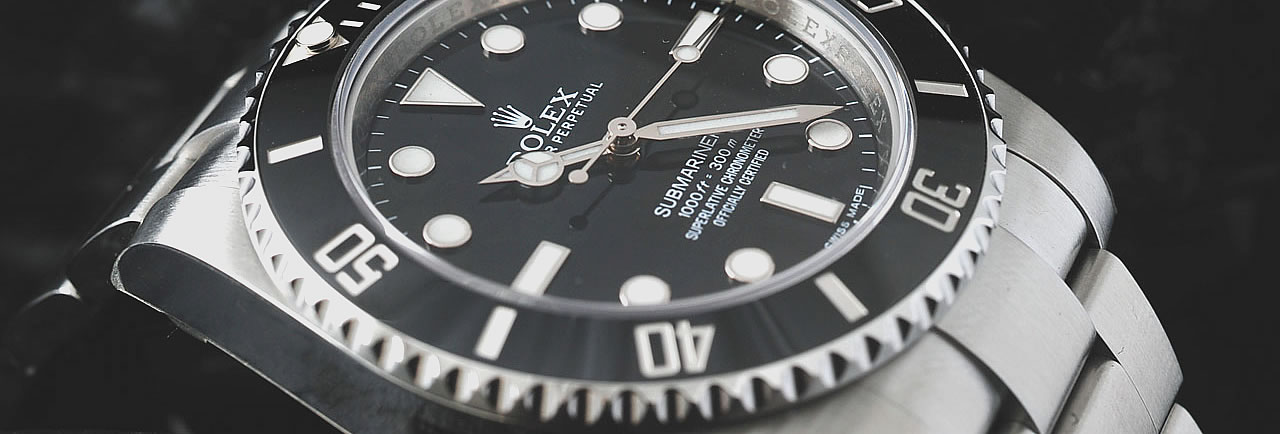
The two generations below let you change one major variable at a time. Compare 114060 with 116610LN to decide whether you want a calendar in the earlier family. Compare 124060 with 126610LN for the equivalent choice in the newer family. To study generation rather than date, compare the two no-date references with each other.
| Reference | Design generation | Published case diameter | Dial and calendar | Original Rolex calibre |
|---|---|---|---|---|
| 114060 | Earlier ceramic-bezel family | 40 mm | Time only; no date window or Cyclops lens | 3130 |
| 116610LN | Earlier ceramic-bezel family | 40 mm | Date at three; Cyclops lens | 3135 |
| 124060 | 41 mm redesign introduced in 2020 | 41 mm | Time only; no date window or Cyclops lens | 3230 |
| 126610LN | 41 mm redesign introduced in 2020 | 41 mm | Date at three; Cyclops lens | 3235 |
The earlier pair is documented in an archived Rolex Submariner brochure; the newer pair appears in Rolex's current reference material. The redesign also altered proportions and bracelet lines, so the 1 mm change in published diameter is not a complete description of wrist fit. Judge an individual replica by its effective case-and-end-link span and fitted bracelet, rather than adding a presumed 1 mm to an older watch's measurements.
How to use the evidence: original-design and movement specifications in this guide describe the named manufacturers' references. No replica sample has been measured or opened for this article. Worked examples below are invented teaching cases. Actual composition, origin, condition and water resistance require evidence for the particular watch; the inspection guide keeps those separate from design selection.
The direct answer to “Swiss Submariner replica”
The phrase can describe a claim about the movement while leaving the case, assembly location and calibre unspecified. “Swiss grade” is even less informative: without a defined specification it gives you no mechanism to compare. ETA 2824-2, by contrast, names a manufacturer and a particular time-and-date calibre. “2824-style” names a design relationship and leaves the actual manufacturer open.
Rolex 3130, 3135, 3230 and 3235 are Rolex calibre references. They are not alternative ETA names. On a replica description, a matching number may name the design being imitated, a claimed clone architecture or an engraving. The useful question is which working movement supplies the hands and calendar.
Two known ETA architectures help explain what a specific answer would change:
| Field | ETA 2824-2 | ETA 2892A2 | Meaning for the comparison |
|---|---|---|---|
| Display and setting features | Central hours, minutes and seconds; date; quick date correction; stop-seconds | Central hours, minutes and seconds; date; quick date correction; stop-seconds | Both are date mechanisms. A no-date dial can conceal a calendar rather than remove it. |
| Published movement diameter × height | 25.60 × 4.60 mm | 25.60 × 3.60 mm | The thinner base leaves a different packaging allowance. Finished-case height also includes the dial, hands, holder, crystal and case back. |
| Balance rate | 28,800 vibrations per hour | 28,800 vibrations per hour | Equal beat rate removes one visible-motion difference; it does not choose the better-regulated individual watch. |
| Published reserve | Typical 42 hours | Typical 50 hours in the current portal; 42 hours in the 2019 technical communication | Keep version and document date with the figure before comparing an older unit. |
For practical use, these references put the calendar controls and service documentation on a concrete footing. They do not make the two movements drop-in replacements: stem position, hand fitting, date-disc placement and dial attachment still have to match the assembled case. A named clone needs its own identification and parts assessment rather than borrowing ETA's parts list.
The movement guide expands the origin, manufacturer and decoration distinction. For a Submariner choice, the extra step is to connect that identity with the date or no-date arrangement you want.
No date on the dial is not always no calendar underneath
A movement built for a date may retain its correction position when used behind a no-date dial. This unused crown position is often called a ghost date position. Some owners are content with it; others prefer time-only controls that correspond to the dial. Make that preference explicit before choosing a no-date configuration.
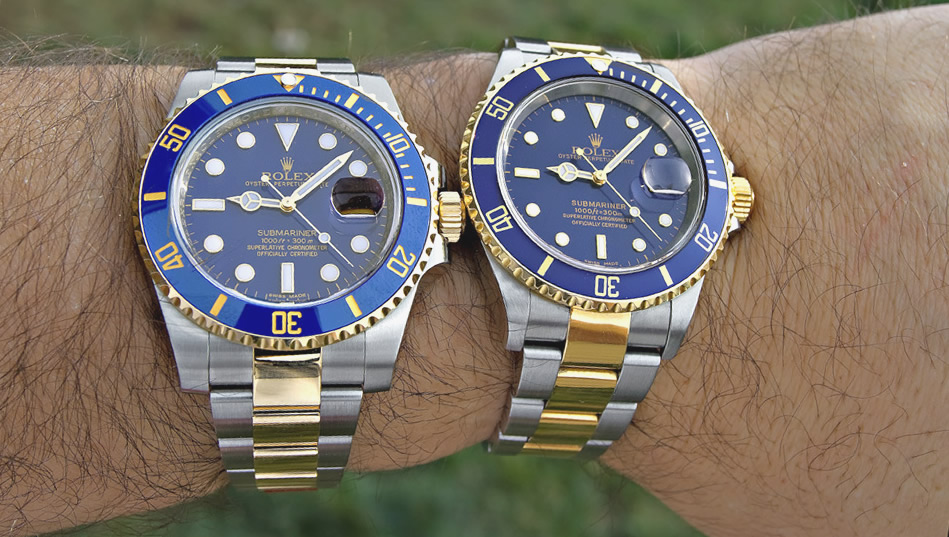
With a Date layout, the date disc, aperture and magnifying lens form one reading system. Inspect a one-digit number and several two-digit numbers, such as 8, 15 and 28, under the same lighting. If only one number appears displaced, investigate the printing or disc placement; if the entire window seems displaced, first square the camera to the dial before attributing it to the watch.
ETA describes the 2824-2's calendar as semi-instantaneous. That is a useful reminder that calendar-transition behavior depends on the mechanism, not the Submariner lettering. Observe a completed daily change using instructions for the identified calibre. The function checks explain how to separate normal running observations from quick-correction controls.
Read a bezel demonstration in three passes
- Set up the view. Use a square-on, stationary view with the bezel reference marker aligned to twelve. Note any offset before operating it.
- Watch a complete turn. In the demonstrated permitted direction, follow the marker around the dial. Listen and watch for inconsistent engagement, not just a pleasing click sound.
- Return and repeat. Bring the marker back to twelve, release it and look again without touching the case. A repeatable offset is more useful to document than one frame taken while the bezel is being pressed sideways.
Suppose the marker appears left of twelve in a tilted photograph but aligns in two square-on stationary views. The reasonable finding is a perspective effect in the first image, not a failed bezel. If it stays left in the repeated square-on views, save those frames as an alignment concern. This separates a visible issue from a camera artifact without inventing a universal click count or tolerance.
Worked choice: choose for the calendar you actually need
Hypothetical teaching case, not tested products. The reader wants a black-bezel, newer-generation layout and uses the date every day. Both candidates have comfortable fitted bracelets, readable hands and acceptable case proportions in the assumed comparison.
| Field | Candidate A | Candidate B | Effect on this reader's choice |
|---|---|---|---|
| Intended design | 126610LN-style, date displayed | 124060-style, no date displayed | Only A supplies the required calendar. |
| Movement description | Identified ETA 2824-2; working date and stop-seconds demonstrated in the invented case | Named time-only clone version; time-setting behavior demonstrated in the invented case | B's more reference-like time-only architecture does not compensate for a missing required function. |
| Date reading | 8, 15 and 28 readable; a full daily advance completes | No date aperture | A meets the specific reading task. |
| Decision | Choose A for this use | Exclude from this shortlist | The decision is about configuration, not a claim that ETA beats every clone. |
If the same reader stopped using the calendar and preferred an uninterrupted dial, B would become the more appropriate layout. That change in preference is the reason to reconsider; an unexplained Swiss label is not. When both candidates have a date and otherwise match, use measured fit, observed calendar behavior and the exact movement's support route to break the tie.
For a date watch with a less prominent bezel, continue to the Datejust size and configuration comparison. For the three-family decision in one place, use the Rolex selection guide.
Reference notes
- Rolex, Submariner archived brochure, “Perpetual movement” and collection pages 16 and 18–19; undated manufacturer document reproduced on Scribd. Used for 114060/116610LN and 3130/3135. Consulted 15 October 2026.
- Rolex, Submariner: From tool watch to icon, 2020 redesign entry; current reference material for 124060-0001 and 126610LN-0001. Checked 15 October 2026.
- ETA, 2824-2 current product record and technical communication CT 2824-2 ESI 481825, version 25, 6 October 2022. Used for functions, dimensions, frequency and typical reserve.
- ETA, 2892A2 current product record, checked 15 October 2026; CT 2892A2 FDE 300054, version 15, 13 February 2019. The reserve figures belong to their respective documents.